

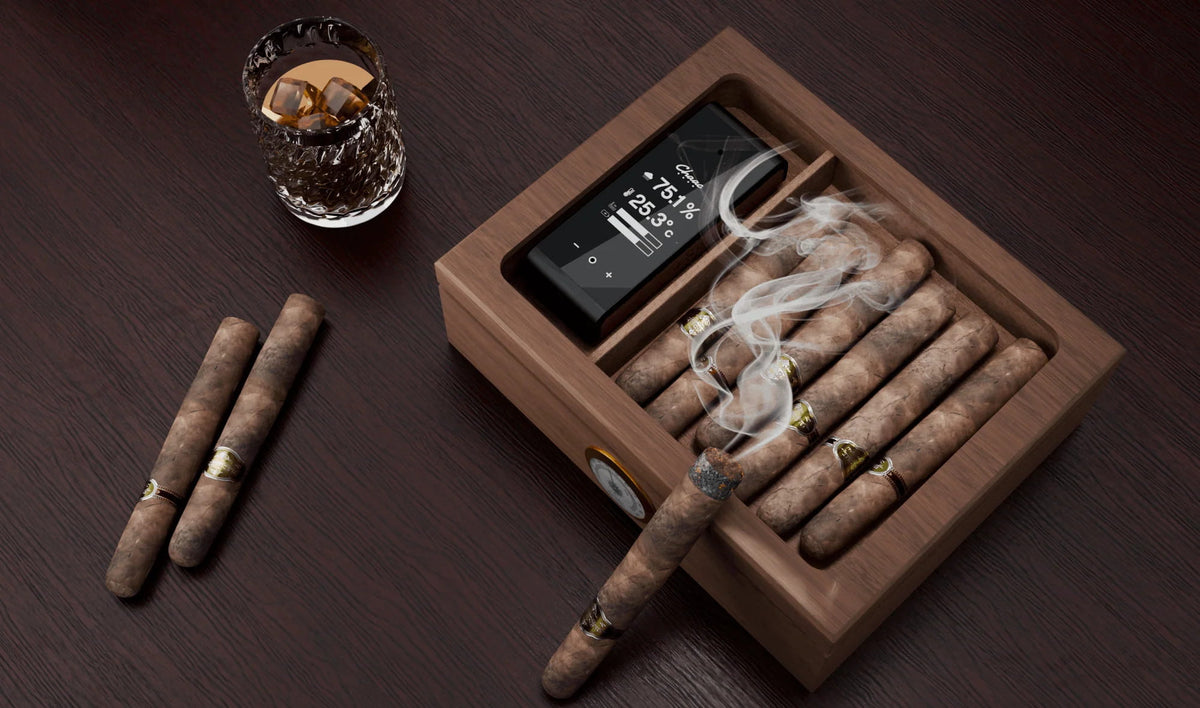
How Long Can Cigars Be Stored Without Losing Quality?
Premium cigars are made to last. Unlike many products that simply become less enjoyable with time, a well-made cigar can remain in excellent condition for years and, in some cases, develop greater complexity as it ages.
The important distinction is that cigars do not have a fixed expiration date. Their condition depends far more on how they are stored than on how much time has passed. A cigar kept in a stable, properly managed humidor can have a cigar shelf life measured in years or even decades. The same cigar left exposed to dry indoor air can begin losing moisture surprisingly quickly.
So, how long can cigars be stored without losing quality? Under consistently suitable conditions, there is no simple universal limit. Some cigars are enjoyed within months; others are deliberately aged for five, ten, or more years.
The real question, then, is not simply how long cigars last. It is whether you can maintain the environment they need for that entire period.
How Long Do Cigars Last in a Humidor?
Potentially for many years.
A humidor creates a controlled environment designed to prevent tobacco from becoming excessively dry or absorbing too much moisture. When that environment remains stable, cigars can retain their condition over extended periods, while certain cigars may continue to mature.
There is an important distinction between preserving and aging a cigar, however.
Preservation is about maintaining the cigar's condition. Aging intentionally gives the tobacco time to develop. Over time, the different tobaccos within a cigar can integrate, sometimes creating a smoother and more nuanced smoking experience.
But longer does not automatically mean better. The cigar itself, its original condition, its blend, and the environment in which it is stored all affect the result.
For collectors interested in long-term cigar storage, consistency is therefore more valuable than simply counting years.
What Determines Cigar Storage Life?
Several factors determine cigar storage life, but they all lead back to one principle: stability.
Humidity
Cigars are highly responsive to the moisture in the air around them.
If humidity remains too low, tobacco gradually loses moisture. The wrapper can become fragile, the cigar may burn differently, and aromas and flavors can diminish.
Too much moisture presents the opposite problem. An overly humid cigar may become difficult to light and burn, while persistently damp conditions can increase the possibility of mold.
Rather than focusing on a single number in isolation, collectors should aim for a suitable range that can be maintained consistently.
Our guide to optimal humidity for cigars explains how humidity influences cigar condition, while which humidity level is best looks more closely at selecting a setting for your collection.
Temperature
Temperature deserves the same attention.
Warm conditions can affect the way moisture behaves inside a humidor and may increase the risk of storage problems. Significant temperature fluctuations can also make it harder to maintain consistent relative humidity.
For that reason, long-term cigar preservation benefits from a cool, stable environment away from direct sunlight, radiators, heating vents, and other sources of substantial temperature change.
The relationship between the two variables is explored further in our guide to how temperature affects cigar aging and flavor.
Humidor Seal Quality
A humidification system can only do so much if the humidor itself cannot retain its environment.
A reliable seal helps limit unnecessary moisture exchange with the surrounding room. Humidor size and construction also influence how easily conditions can be maintained.
This becomes particularly important for collections intended to remain stored for several years. Small inconsistencies repeated over a long period can become more significant than brief changes.
Air Circulation
A humidor should hold your collection without restricting the movement of humidified air.
When cigars are packed too tightly, different areas of the humidor may experience slightly different conditions. Leaving enough room for air to move helps create a more uniform storage environment.
For larger or long-term collections, understanding how air circulation improves cigar preservation can help you arrange your humidor more effectively.
How Often Conditions Change
A cigar may spend years inside a humidor, which makes small daily habits surprisingly important.
Every time a humidor is opened, some of its controlled internal air is exchanged with the surrounding room. The humidification system then has to restore the desired environment.
That does not mean a humidor should remain permanently closed. It simply means unnecessary opening can make maintaining stable conditions more difficult.
If you regularly check your collection, our guide to opening the humidor every day explains what happens when the lid is opened frequently.
Seasonal changes matter as well. Indoor heating, air conditioning, and changing ambient humidity can alter the environment surrounding the humidor. Understanding how weather changes affect cigar humidity can help you prepare for these fluctuations.
Does Aging Always Make a Cigar Better?
Not necessarily.
Aging changes tobacco, but whether that change is desirable depends on the cigar and the person smoking it.
With time, some cigars become more harmonious. Stronger edges can soften, and individual components of a blend may become more integrated. For collectors who appreciate that evolution, aging can become part of the pleasure of maintaining a premium collection.
Other cigars may be at their most expressive earlier in their lives. Extended aging can soften characteristics that some smokers would rather preserve.
There is therefore no reason to age a cigar simply because you can.
For those building a collection specifically for maturation, our guide to aging premium cigars looks more closely at the process.
How to Store Cigars for the Long Term
Knowing how to store cigars for years comes down to creating the right environment and then disturbing it as little as reasonably possible.
Begin with a well-constructed humidor with an effective seal. Keep it away from direct sunlight and major temperature swings. Avoid packing cigars so tightly that air cannot circulate freely.
Then focus on humidity management.
For a small collection you smoke regularly, occasional manual monitoring may feel manageable. A collection intended to remain undisturbed for years creates a different requirement: the environment needs to remain controlled even when you are not thinking about it.
This is where automated cigar humidifiers can become especially valuable.
CHAAC is designed as a complete humidification system rather than simply a device that reports humidity. Its sensors evaluate conditions inside the humidor while the system actively manages moisture according to the selected setting.
The goal is simple: greater control with less routine intervention.
Choose the Right Level of Control
Different collections require different levels of oversight.

The Chaac Patuca cigar humidifier provides automated humidity regulation with built-in audible alerts for humidity, water, and battery conditions.
The Chaac Grande cigar humidifier adds connected monitoring and control, allowing you to review humidity, temperature, battery status, and water level remotely. It also provides historical information and more advanced collection-management capabilities.
For a collection being preserved over several years, visibility can be particularly useful. Instead of repeatedly opening the humidor simply to inspect its conditions, connected monitoring makes it possible to keep an eye on the environment while leaving the collection undisturbed.
CHAAC is specifically positioned around this combination of active humidity management, remote visibility, and reduced maintenance, turning an existing humidor into a connected preservation system.
If you are deciding how much control your collection needs, read our guide to automatic vs. manual cigar humidifiers.
What Can Shorten Cigar Storage Life?
Most cigars do not lose quality simply because another year has passed. Problems arise when their environment stops protecting them.
Common risks include prolonged low humidity, excessive humidity, large temperature swings, poor humidor seals, insufficient air circulation, and neglected humidification equipment.
Some problems happen gradually enough to escape notice.
A slowly drying humidor may not create an obvious problem overnight. But weeks or months of unsuitable conditions can affect an entire collection.
The same applies to excessive moisture. If you suspect your collection is holding too much moisture, our guide to cigars’ over-humidification explains the warning signs.
You can also review the most common cigar storage mistakes before committing valuable cigars to extended storage.
Can a Dry Cigar Be Saved?
A slightly dry cigar may sometimes be reconditioned, but restoration should be approached carefully.
Dry tobacco should not be exposed to a dramatic increase in humidity. As the tobacco absorbs moisture and expands, the wrapper can become vulnerable to cracking or splitting.
Gradual rehumidification gives the cigar time to adjust.
However, returning moisture to tobacco does not guarantee that its original qualities will return completely. Severe or prolonged dryness can permanently affect flavor and aroma.
Our guide to recovering over-dried cigars explains how to approach recovery carefully.
For a valuable collection, prevention remains considerably more desirable than restoration.
Long-Term Cigar Storage is an Exercise in Consistency
There is something inherently patient about maintaining a cigar collection.
Some cigars will be selected for the coming weekend. Others may remain untouched for years, waiting until their character, or the occasion, feels right.
The humidor's role is to make that choice possible.
Rather than thinking about cigar shelf life as a fixed expiration date, think about the quality of the environment surrounding the cigar throughout its life. Stable humidity, controlled temperature, suitable air circulation, and reliable monitoring give premium tobacco the conditions it needs to remain at its best.
CHAAC was created around this principle. Patuca and Grande are designed to upgrade an existing humidor with automated humidity management, reducing the need for repeated manual adjustments while keeping the collector informed when attention is required.
For collectors building a serious long-term collection, that means less time wondering what is happening inside the humidor and more confidence that each cigar is being preserved for the moment you choose to enjoy it.
Frequently Asked Questions (FAQs)
1. How long can cigars be stored?
Premium cigars can potentially be stored for many years when humidity, temperature, and other environmental conditions remain suitable. There is no universal expiration date that applies to every cigar.
2. How long do cigars last in a humidor?
Properly maintained cigars can remain in a humidor for years, including ten years or longer in suitable circumstances. The quality of the storage environment matters more than the number of years alone.
3. Do cigars expire?
Not in the same way as food or other perishable products. Cigars gradually respond to their environment and continue to change with age. Poor storage can damage them, while suitable conditions can preserve them for extended periods.
4. What is the best humidity for long-term cigar storage?
The ideal setting can vary depending on the cigar, temperature, and personal preference. The priority for long-term storage is maintaining an appropriate range consistently rather than allowing repeated swings between excessively dry and humid conditions. For a closer look at the subject, see our guide to relative humidity matters for premium cigars.
5. Can cigars be stored for 20 years?
Some premium cigars can remain in good condition for decades when they have been stored exceptionally well. Whether a cigar will improve for that long is a different question and depends on the tobacco, blend, and individual preference.
6. How do you know if an old cigar is still good?
Inspect its wrapper and overall condition. Look for signs of severe dryness, cracking, mold or other damage. Storage history is also important. A cigar's age alone tells you very little about how well it has been preserved.
7. Should you keep cigars in their original boxes inside a humidor?
Boxes can be useful for organizing and aging larger collections, provided the humidor has sufficient space and the storage arrangement allows appropriate environmental control and air movement.
8. What matters most for long-term cigar storage?
Consistency. Stable humidity, suitable temperature, a quality humidor, adequate circulation, and reliable monitoring matter more than repeatedly chasing an exact reading. For a collection intended to mature over many years, maintaining a controlled environment is the foundation of cigar longevity.