
65%, 69%, or 72% RH: Which Humidity Level Is Best?
A few percentage points can noticeably change how a cigar feels, draws, burns, and develops over time. That is why choosing between 65%, 69%, and 72% relative humidity (RH) is more than a matter of personal preference. Your target should reflect your cigars, humidor, climate, and smoking habits.
For most collections, 69% RH is the most dependable starting point. It provides a balanced environment without moving too far toward dryness or excess moisture. Still, 65% can improve combustion and flavor clarity for some smokers, while 72% may suit specific cigars or particularly dry storage conditions when temperature and airflow are carefully controlled.
So, which humidity level is best? The answer depends on what you expect from your collection and how consistently you can maintain its environment. The generally accepted storage range is 65% to 72% RH, with 69% commonly chosen as an all-around setting.
Understanding Cigar Humidor Humidity
Relative humidity (RH) measures the moisture in the air compared with the maximum amount the air can hold at the same temperature. Inside a humidor, that moisture affects tobacco elasticity, combustion, aroma, and long-term condition.
This is why relative humidity matters for cigars. Tobacco absorbs and releases moisture as its surroundings change. If the environment is too dry, wrappers may become brittle, and cigars can burn hot and fast. If it is too humid, tobacco may swell, restrict the draw, burn unevenly, or become more vulnerable to mold.
A useful cigar humidity guide therefore treats 65% to 72% RH as an operating range, not a universal rule. The goal is not to chase a perfect number every hour. It is to maintain stable conditions that support the smoking experience you prefer.
65% RH: A Drier, Cleaner Smoking Experience
At 65% RH, cigars generally feel firmer and may be easier to keep lit. Lower moisture can support an open draw, clean combustion, and sharper flavor definition.
Consider 65% RH when:
- You prefer a firmer cigar and a responsive draw.
- Your cigars feel soft or burn unevenly at higher settings.
- You live in a humid climate.
- You smoke regularly instead of aging most of your collection.
65% RH is positioned as a specialty setting for smokers who prefer a drier cigar profile or easier combustion. It may also work well in humid regions or tightly sealed storage systems.
This setting can provide a useful margin during humid seasons. Understanding how weather changes affect cigar humidor conditions is especially important where outdoor humidity or indoor HVAC use changes sharply.
However, 65% requires consistency. If the humidor leaks or the room is very dry, the RH may fall below your target. For cigars already affected by dryness, use a gradual method for recovering over-dried cigars rather than raising humidity abruptly.
69% RH: The Best All-Around Setting
For most owners, 69% RH offers a strong balance of preservation, burn quality, and easy management. It also allows for small, normal fluctuations without immediately moving the collection into an undesirable range.
If you are searching for the best humidity level for cigars, 69% is the most practical baseline. It works across a broad range of wrappers, sizes, and humidor styles. Cigars generally remain supple without feeling overly soft, while combustion stays predictable.
At approximately 69% RH, you can typically expect:
- Good wrapper flexibility and a balanced draw.
- Consistent lighting and combustion.
- Enough moisture for medium- and long-term storage.
- More margin than 72% if temperature rises.
We identify approximately 69% RH as a reliable everyday setting for a broad range of cigar storage systems.
If the humidor remains near 69% but cigars still feel wet or dry, look beyond the target. Sensor placement, temperature, sealing, overcrowding, and uneven air distribution may be responsible. Reviewing common cigar storage mistakes helps separate a true humidity issue from a wider storage problem.
It is also important to understand how temperature affects cigar aging and flavor. A stable RH reading does not tell the whole story when the storage area becomes significantly warmer or cooler.
72% RH: More Moisture, Less Margin for Error
At 72% RH, cigars retain more moisture and may feel softer and more pliable. Some smokers prefer this texture for delicate wrappers or collections kept in extremely dry environments.
The trade-off is a narrower safety margin. A small upward swing can contribute to tight draws, repeated relights, uneven burning, musty aromas, or mold. Higher temperature increases the concern. 72% RH is recommended as a specialized choice for dry environments, drafty humidors, or smokers who prefer a higher-moisture profile.
Before choosing this level, review the signs of cigar over-humidification and pay attention to the cigars themselves. If several feel spongy, resist airflow, or repeatedly go out, the collection may be carrying too much moisture.
Consider 72% only when your environment is reliably dry, or you clearly prefer a softer cigar. When aging premium cigars, prioritize stability, airflow, and gradual adjustments rather than simply selecting the highest acceptable RH.
What Determines the Right RH?
The ideal setting is personal, but it should not be arbitrary. Consider the full storage system before selecting a cigar humidor humidity percentage.
Humidor Construction and Seal
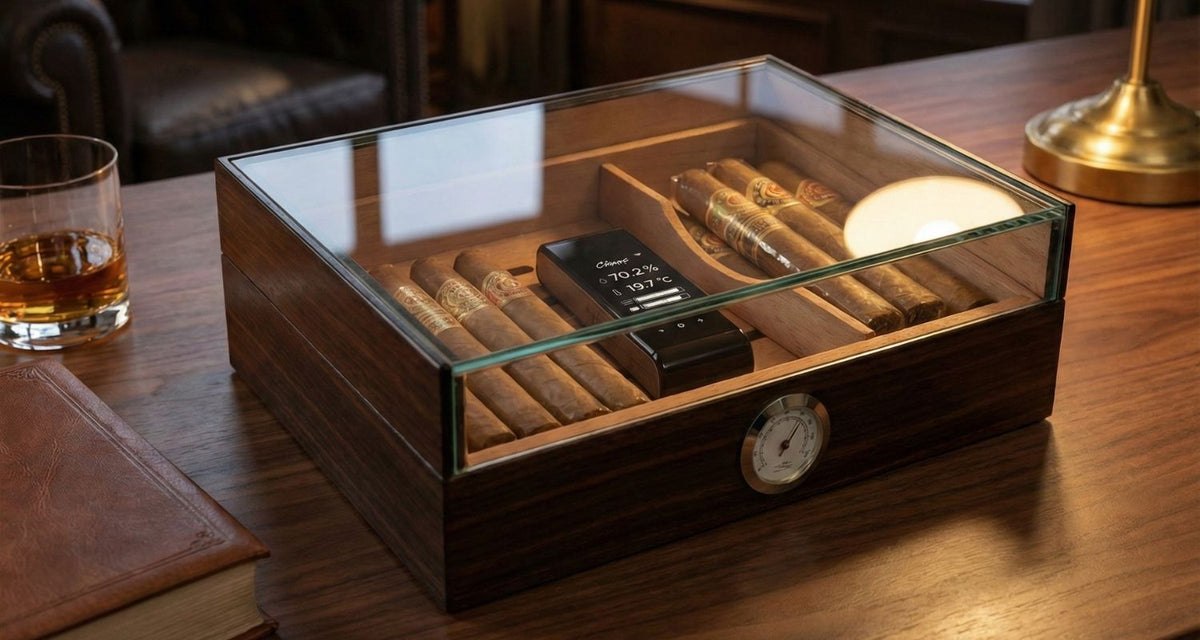
A properly seasoned, well-sealed humidor buffers environmental changes and recovers more effectively after opening. A weak seal allows RH to drift and forces the humidification system to work harder.
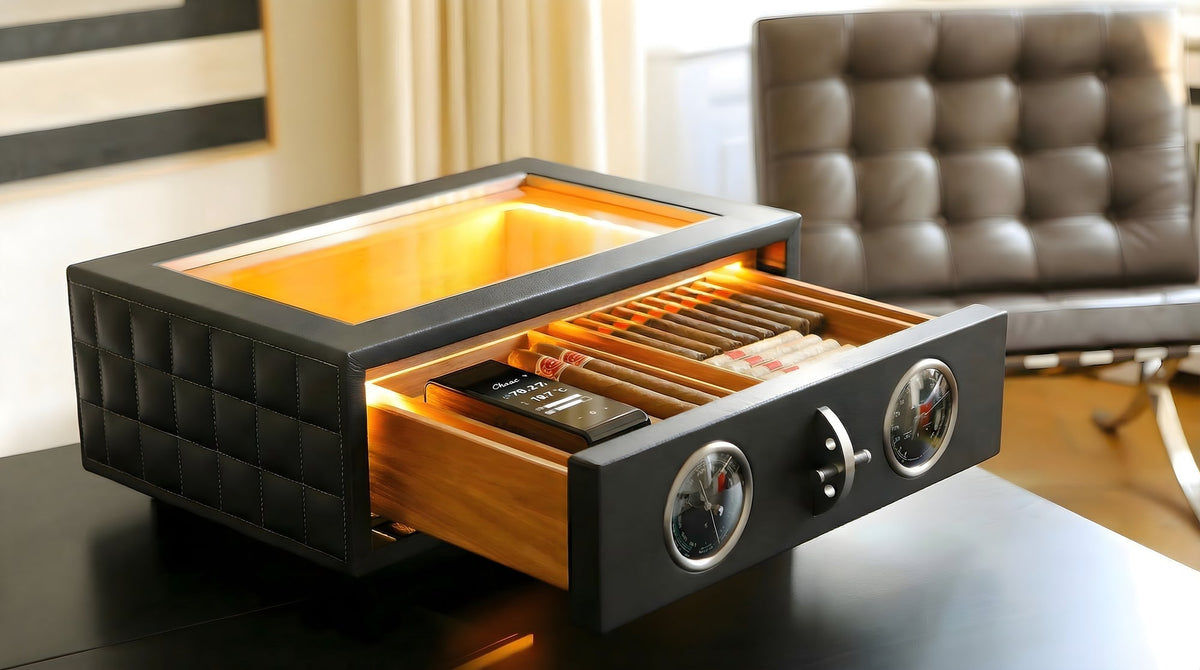
Before fine-tuning the setting, understand how to choose the right cigar humidor for your collection size and intended storage period. A tightly sealed acrylic container, a traditional cedar humidor, and large cabinet will not respond to moisture in exactly the same way.
Temperature and Seasonal Conditions
Keep your humidor away from direct sunlight, radiators, vents, and heat-producing electronics. Winter heating can dry indoor air, while humid summers can increase the environmental load.
Instead of reacting to every temporary reading, monitor longer-term patterns. A short fluctuation after opening the lid is less concerning than a steady rise or decline lasting several days.
Collection Size and Storage Duration
A small collection that turns over quickly may perform well at 65% to 69%. Your approach should also reflect how long cigars stay stored, since a box held for several weeks has different demands from one intended to rest for years.
Long-term collections benefit from dependable monitoring, gradual adjustments, and enough space for air to move around boxes and individual cigars.
Opening Frequency
Every opening exchanges air with the room. There is nothing inherently wrong with opening a humidor every day, but frequent access can produce short-term swings, especially in a small desktop humidor.
Allow the system time to recover before changing the target or adding more moisture. Repeatedly adjusting the humidifier after every minor fluctuation can create more instability than the opening itself.
Choosing the Right Humidity-Control Method
Your target matters only if your system can maintain it. Passive packs can work well in compact, well-sealed humidors. Active systems add sensing, controlled moisture delivery, and circulation for greater precision.
Manual vs. Active Control
A comparison of automatic versus manual cigar humidifiers can clarify how much maintenance you want. Traditional solutions require routine checks and replacement, while electronic cigar humidifiers reduce guesswork by actively monitoring the environment.
Air movement becomes particularly important in cabinets with several trays or shelves. Understanding how air circulation improves cigar preservation can help prevent damp areas near the humidifier and dry zones farther away. Active circulation distributes conditioned air more evenly throughout the available space.
Smart Control for Different Collections
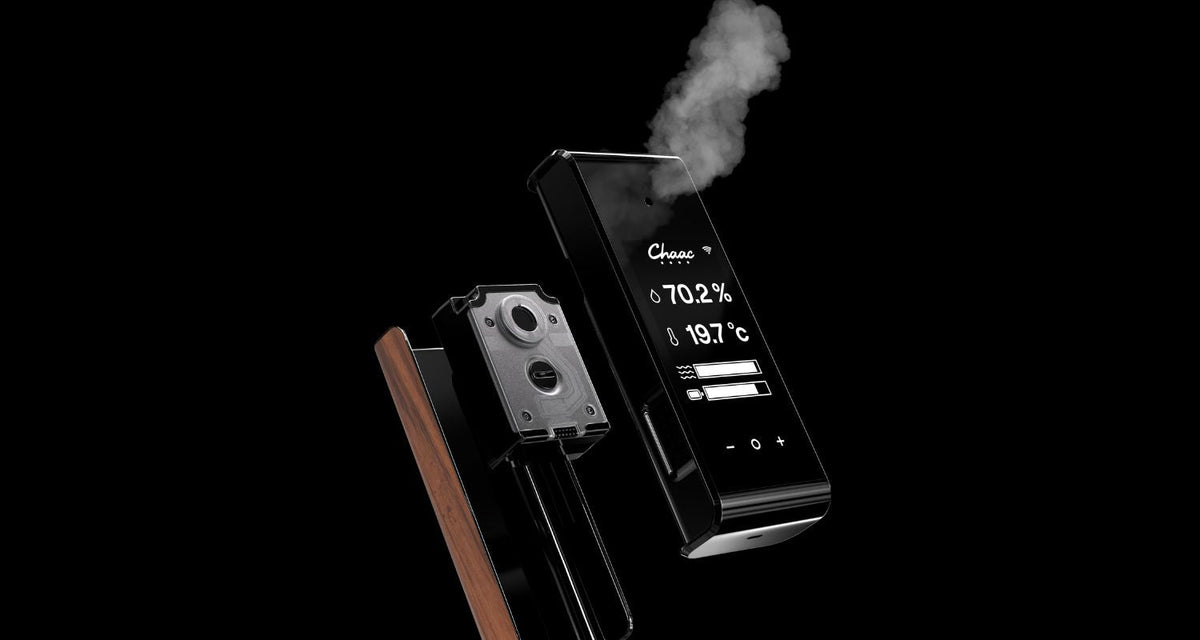
For low-maintenance precision, Chaac’s Patuca cigar humidifiers automatically monitor conditions and provide audible alerts for humidity, water, and battery needs.
For remote monitoring, app-based control, device grouping, smart alerts, and advanced analytics, Chaac’s Grande cigar humidifiers provide a more connected approach. Grande allows you to monitor humidity, temperature, battery status, and water levels through the Chaac app.
Regardless of the system, select one target and let the humidor stabilize. Look for patterns over several days and evaluate cigars from different areas.
Start at 69%, Then Fine-Tune
For most owners, start at 69% RH and observe the collection for two to four weeks. Check the draw, burn rate, wrapper condition, and recovery after opening.
Then adjust carefully:
- Move toward 65% if cigars feel too soft, draw tightly, or need frequent relighting.
- Remain near 69% if the burn, draw, and flavor are balanced.
- Consider 72% only if conditions are consistently dry and you prefer a softer cigar.
- Change the target by one or two percentage points at a time.
This measured approach is the safest way to find your optimal humidity for cigars without exposing the collection to repeated swings.
Find the RH That Protects How You Smoke
The choice between 65%, 69%, and 72% RH is a choice between a drier, balanced, or more moisture-rich environment. For most collections, 69% is the best starting point. Fine-tune gradually according to cigar performance, room conditions, humidor quality, and personal preference.
At Chaac, we believe premium cigar care should be precise without becoming demanding. Choose a stable target, monitor the complete environment, and let intelligent humidification protect the consistency behind every exceptional cigar.
Frequently Asked Questions
1. Is 65% RH too low for cigars?
No. Many cigars perform well at 65% RH, especially when you prefer an open draw, clean combustion, and a firmer feel.
2. Is 72% RH too high for cigars?
Not automatically, but it requires closer monitoring. Warm temperatures, weak airflow, or inaccurate readings make 72% less forgiving.
3. Is 69% RH best for every cigar?
No single setting is perfect for every cigar, but 69% is the most versatile starting point for most home collections.
4. How long should I wait after changing humidity?
Allow several days for the environment to stabilize and longer for the cigars to adjust. Do not judge the result after only a few hours.
5. Should I combine humidity devices?
Use one system designed for the humidor’s volume. Combining methods that regulate toward different set points can make humidity control less predictable.